Visa Changes for Tech Talent: Solutions for IT Professionals

International IT professionals in the United States face evolving visa regulations, necessitating a proactive approach to understanding new requirements and leveraging available pathways for continued employment and career growth.
Understanding Visa Changes for Tech Talent: Solutions for International IT Professionals is more crucial than ever in today’s dynamic employment landscape. As regulations shift, staying informed about the latest immigration policies is not just beneficial, but essential for those building a career in the American tech industry.
The evolving landscape of US tech visas
The United States has long been a magnet for global tech talent, drawing innovators and specialists from around the world. However, the regulatory environment surrounding work visas, particularly for high-skilled professionals, is in constant flux. Recent years have seen significant discussions and adjustments to policies that directly impact international IT professionals seeking to work in the US.
Understanding these changes is the first step toward navigating them successfully. The H-1B visa, for example, remains a primary pathway for many, but its lottery system, cap limits, and increasingly stringent adjudication standards demand careful preparation and strategic planning. Beyond H-1B, other visa categories and potential reforms are always on the horizon, requiring a vigilant eye from both employers and prospective employees.
Key policy shifts and their impact
Several policy shifts have reshaped the immigration landscape for tech talent. These often stem from broader economic and political considerations, influencing how visas are processed and who qualifies. Staying abreast of these changes is vital for long-term career planning.
- Increased scrutiny and RFE rates: Requests for Evidence (RFEs) have become more common, requiring applicants to provide extensive documentation to prove specialized knowledge and employer-employee relationships.
- Wage level considerations: There’s a growing emphasis on ensuring foreign workers are paid prevailing wages commensurate with their skills and experience, impacting eligibility and employer commitments.
- ‘Buy American, Hire American’ executive orders: While not always directly changing statutes, these directives have influenced the interpretation and enforcement of existing immigration laws, leading to a more cautious approach.
The cumulative effect of these changes is a more complex and often lengthier application process. International IT professionals must be prepared for potential delays and the need for robust, well-documented petitions. Employers, in turn, are increasingly investing in legal counsel and internal processes to ensure compliance and support their foreign workforce.
Navigating the H-1B visa: strategies and challenges
The H-1B visa program is arguably the most critical and competitive pathway for international tech talent to work in the US. Each year, demand far outstrips the available supply, making strategic preparation essential. Understanding the nuances of the H-1B lottery, eligibility criteria, and the application process is paramount for success.
The annual H-1B cap, typically 85,000 visas (including 20,000 for those with a US master’s degree or higher), means that even highly qualified candidates face significant odds. The electronic registration process, introduced in recent years, has streamlined the initial step but intensified the competition for selection. Employers must register prospective employees, and only those selected in the lottery can proceed with a full petition.
Optimizing your H-1B application
For those fortunate enough to be selected, the subsequent petition phase requires meticulous attention to detail. Common challenges include demonstrating the specialty occupation requirement, proving the employer-employee relationship, and establishing the candidate’s qualifications. Preparing a strong petition involves several key elements:
- Detailed job descriptions: Clearly articulate the specialized nature of the role and how it requires a bachelor’s degree or higher in a specific field.
- Strong educational background: Provide comprehensive transcripts and degree evaluations to support the candidate’s qualifications.
- Employer-employee relationship: Document how the employer maintains control over the employee’s work, especially for consulting roles.
Furthermore, the timing of the application is critical. The H-1B cap season typically begins in March for registrations, with selected petitions filed in April for an October 1st start date. Missing these deadlines can mean waiting another year. Employers and candidates should work closely with experienced immigration attorneys to ensure all requirements are met and the petition is as robust as possible.
Alternative visa options for tech professionals
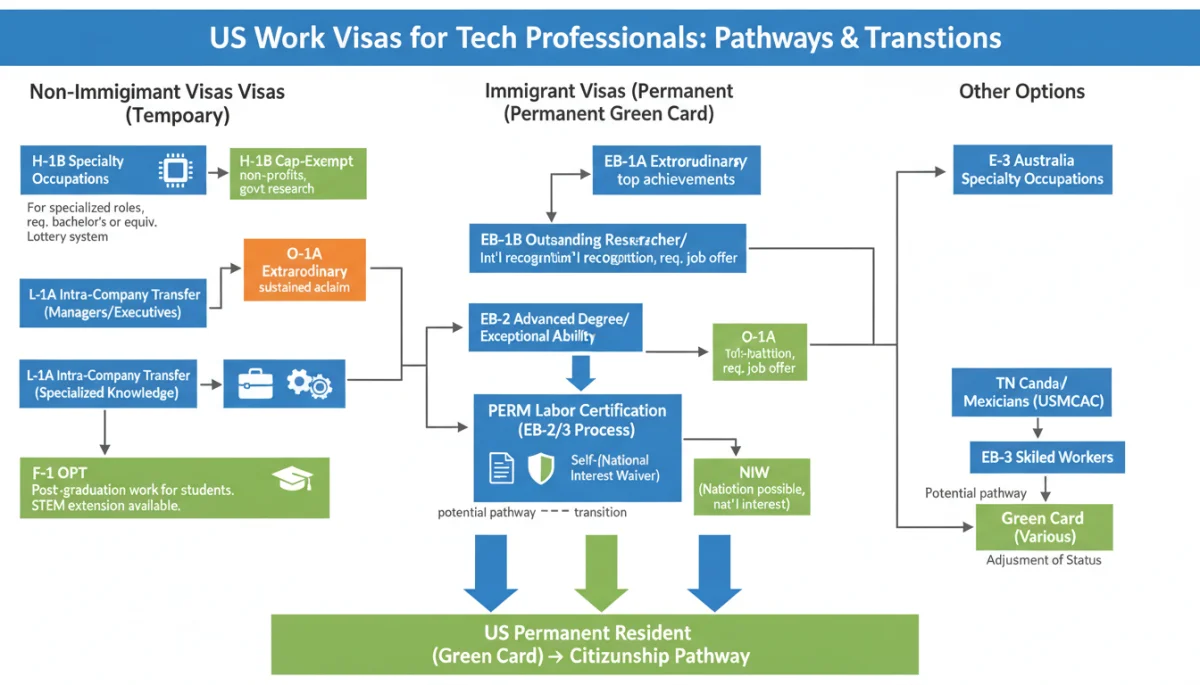
While the H-1B visa is prominent, it is not the only avenue for international tech talent. Exploring alternative visa categories can provide viable solutions, especially for those who may not qualify for the H-1B or seek different long-term immigration goals. These options often cater to specific skill sets, professional achievements, or employer types.
The O-1A visa for individuals with extraordinary ability, for instance, is a compelling option for highly accomplished tech professionals. This visa requires demonstrating sustained national or international acclaim in their field, often evidenced by publications, awards, high salaries, or critical roles in distinguished organizations. While stringent, it offers greater flexibility than the H-1B as it is not subject to an annual cap.
Exploring other work visa categories
Beyond O-1A, several other categories may be relevant, depending on individual circumstances and the nature of the employment:
- L-1 visa for intracompany transferees: Ideal for tech professionals working for multinational companies with US offices. It allows for transfer to the US if they have worked for the foreign entity for at least one year in a managerial, executive, or specialized knowledge capacity.
- E-3 visa for Australian nationals: A specialized visa category exclusively for Australian citizens working in specialty occupations, similar to the H-1B but with a separate, less competitive cap.
- TN visa for Canadian and Mexican nationals: Available under NAFTA/USMCA for certain professionals, including computer systems analysts, engineers, and scientists. This offers a relatively straightforward path for eligible citizens.
Each of these visas has unique requirements and benefits. A thorough assessment of a candidate’s profile, coupled with an understanding of their prospective employer’s structure, is essential to determine the most suitable option. Early planning and expert legal advice can illuminate these alternative paths and maximize the chances of successful immigration.
Employer-sponsored green card pathways
For many international tech professionals, the ultimate goal is often to secure permanent residency, or a green card, in the United States. Employer sponsorship is a common and robust pathway to achieving this. The process typically involves several stages, beginning with labor certification and culminating in the adjustment of status or consular processing.
The most common employer-sponsored green card categories fall under Employment-Based (EB) visas. The EB-2 (for professionals with advanced degrees or exceptional ability) and EB-3 (for skilled workers, professionals, and other workers) categories are frequently utilized by tech companies. The process usually starts with the PERM Labor Certification, where the employer must demonstrate that there are no qualified US workers available for the position.
Understanding the PERM and I-140 processes
The PERM Labor Certification is a critical and time-consuming first step. It involves a rigorous recruitment process to test the US labor market, ensuring that hiring a foreign worker will not adversely affect US workers. Once certified by the Department of Labor, the employer can then file Form I-140, Immigrant Petition for Alien Worker, with USCIS.
- PERM Labor Certification: Requires specific advertising and recruitment efforts to prove a lack of qualified US workers.
- Form I-140: Establishes the foreign national’s eligibility for an employment-based immigrant visa, based on their qualifications and the employer’s offer.
- Priority dates and visa bulletin: Depending on the country of origin and visa category, there may be significant backlogs, requiring applicants to wait for their priority date to become current before filing for adjustment of status.
Navigating the green card process demands patience and precision. The waiting times can vary significantly, especially for individuals from countries with high demand. However, securing an employer-sponsored green card provides long-term stability and career opportunities, making it a highly sought-after solution for international tech talent.
Strategic planning for long-term residency
Successful immigration for international tech talent in the US is rarely a short-term endeavor; it requires strategic, long-term planning. This involves not only understanding current visa options but also anticipating future regulatory changes, building a strong professional profile, and continually adapting to new requirements. Proactive engagement with immigration processes is key to achieving permanent residency and career stability.
One crucial aspect of long-term planning is maintaining an impeccable immigration record. Adhering to all visa terms, avoiding overstays, and promptly responding to any government inquiries are essential. Any misstep can jeopardize future applications, making diligence a non-negotiable part of the process. Furthermore, continuously enhancing professional skills and credentials can strengthen future petitions.
Building a robust immigration profile
Developing a strong immigration profile goes beyond just meeting minimum requirements. It involves actively contributing to the tech community and demonstrating exceptional value:
- Professional development: Pursuing advanced degrees, certifications, and specialized training can enhance qualifications for higher-tier visa categories.
- Publications and presentations: Contributing to industry journals, presenting at conferences, or holding patents can bolster claims for visas like the O-1A.
- Community involvement: Participating in tech meetups, mentorship programs, or open-source projects demonstrates leadership and engagement.
Moreover, building strong relationships with employers who are knowledgeable and supportive of immigration processes is invaluable. Companies that have experience sponsoring visas and green cards can provide crucial support and guidance throughout the journey. Ultimately, a blend of personal initiative, professional excellence, and expert legal advice forms the bedrock of a successful long-term immigration strategy.

Resources and support for international IT professionals
The journey through US immigration for international IT professionals can be complex and daunting. Fortunately, a wealth of resources and support systems exist to help navigate these challenges. From specialized legal counsel to professional organizations and online communities, tapping into these networks can provide invaluable guidance, information, and a sense of community.
Immigration attorneys specializing in employment-based visas are perhaps the most critical resource. They can offer personalized advice, assess eligibility for various visa types, prepare petitions, and represent clients before government agencies. Their expertise is essential for ensuring compliance with constantly changing regulations and maximizing the chances of a successful outcome.
Leveraging professional networks and organizations
Beyond legal support, several other resources can aid international tech talent:
- Professional organizations: Groups like IEEE, ACM, or local tech associations often host events, provide networking opportunities, and sometimes offer resources related to international talent.
- Online communities and forums: Platforms dedicated to immigration for tech professionals can offer peer support, shared experiences, and up-to-date information on trends and challenges.
- University international student offices: For those transitioning from student visas (F-1 OPT/STEM OPT), university offices often provide guidance on initial work authorization and pathways to H-1B.
Employers also play a vital role, often providing internal immigration teams or partnering with external law firms to support their international workforce. These resources, combined with a proactive and informed approach from the individual, create a robust support structure for international IT professionals striving to build successful careers in the United States. Staying connected and informed is key to overcoming obstacles and achieving immigration goals.
| Key Point | Brief Description |
|---|---|
| H-1B Visa Challenges | High competition and increased scrutiny necessitate meticulous preparation for the annual lottery and petition process. |
| Alternative Visa Options | O-1A, L-1, E-3, and TN visas offer pathways for specific skills, company transfers, or nationalities. |
| Green Card Pathways | Employer-sponsored EB-2/EB-3 visas involve PERM labor certification and I-140 petitions for permanent residency. |
| Strategic Long-Term Planning | Maintain an impeccable immigration record, enhance professional credentials, and leverage expert legal advice for stability. |
Frequently asked questions about tech talent visas
The main challenges include the highly competitive H-1B lottery, increased scrutiny during the application process, and often lengthy waiting periods for green card processing, especially for certain nationalities. Keeping up with evolving regulations also poses a significant hurdle.
While the lottery is random, having an advanced degree from a US institution increases eligibility for the master’s cap, which has slightly better odds. Ensuring a strong, well-documented petition once selected is also crucial for approval.
Alternative visas include the O-1A for extraordinary ability, L-1 for intracompany transferees, E-3 for Australian citizens, and TN for Canadian and Mexican professionals. Each has specific criteria based on skills, employer, or nationality.
It usually starts with the PERM Labor Certification to prove no qualified US workers are available. Then, the employer files Form I-140. Finally, the individual applies for adjustment of status or consular processing when their priority date is current.
Legal counsel is extremely important. Experienced immigration attorneys provide expert advice, ensure compliance with complex regulations, prepare robust petitions, and represent clients, significantly increasing the likelihood of successful outcomes and reducing potential errors.
Conclusion
The landscape of US visa changes for tech talent demands constant vigilance and strategic adaptation from international IT professionals. By thoroughly understanding the complexities of the H-1B, exploring alternative visa pathways, diligently pursuing employer-sponsored green cards, and leveraging available resources, tech talent can effectively navigate these challenges. Proactive planning, coupled with expert legal guidance, remains the most reliable strategy for building and sustaining a successful career in the dynamic American tech industry.
