Federal Student Loan Forgiveness: Your Complete Guide

Federal student loan forgiveness programs offer pathways for borrowers to reduce or eliminate their debt under specific conditions, providing crucial financial relief for many Americans.
Navigating the complexities of student loan debt can feel overwhelming, but understanding the options available for relief is a critical step towards financial freedom. This comprehensive resource aims to demystify federal student loan forgiveness programs, offering clear, actionable insights into what you need to know.
Understanding the landscape of federal student loan forgiveness
The concept of federal student loan forgiveness can often seem like a distant dream for many borrowers. However, various programs exist that can significantly reduce or even eliminate your student debt if you meet specific criteria. These programs are not one-size-fits-all, ranging from those tied to public service to others based on income or disability.
It is essential to distinguish between forgiveness, cancellation, and discharge, as these terms are often used interchangeably but have distinct meanings in the context of student loans. While all three result in no longer having to repay your loan, the conditions and processes for each differ significantly, impacting your eligibility and how you pursue relief.
Key distinctions: forgiveness, cancellation, and discharge
Understanding the nuances between these terms is the first step in identifying the right path for your situation. Each category has its own set of rules and requirements, making it crucial to familiarize yourself with them.
- Forgiveness: Typically refers to programs where your loan debt is eliminated due to your job or other specific service, such as public service or teaching in certain areas.
- Cancellation: Often used interchangeably with forgiveness, but sometimes refers to specific types of relief related to school closures or other institutional issues.
- Discharge: Generally applies to situations where you are no longer required to pay your loans due to circumstances like total and permanent disability, death, or bankruptcy (though bankruptcy discharge is rare).
By grasping these fundamental differences, borrowers can more accurately assess which avenues for relief might be applicable to their personal and professional circumstances, setting the stage for a more targeted approach to debt management.
Public service loan forgiveness (PSLF): a path for public servants
For those dedicated to careers in public service, the Public Service Loan Forgiveness (PSLF) program offers a compelling opportunity to have their federal student loan debt erased. This program is designed to encourage individuals to work in government or non-profit sectors, acknowledging the often lower salaries associated with these vital roles.
Eligibility for PSLF hinges on several key factors, including the type of loans you have, your repayment plan, and your employer. Meeting all these requirements consistently over a decade is crucial for successful forgiveness.
Eligibility criteria for PSLF
To qualify for PSLF, borrowers must meet strict criteria. Understanding these requirements from the outset is vital to ensure you are on the right track.
- Eligible loans: Only Federal Direct Loans qualify. If you have FFEL or Perkins Loans, you’ll need to consolidate them into a Direct Consolidation Loan.
- Eligible employment: You must work full-time for a U.S. federal, state, local, or tribal government organization, or a non-profit organization that is tax-exempt under Section 501(c)(3) of the Internal Revenue Code.
- Qualifying payments: You need to make 120 qualifying monthly payments under a qualifying repayment plan. These payments must be made on time, for the full amount due, and while employed full-time by a qualifying employer.
The journey to PSLF requires diligent record-keeping and annual certification of employment to track your progress accurately. Any misstep can delay or jeopardize your forgiveness, making attention to detail paramount throughout the 10-year period.
Income-driven repayment (IDR) plans and their forgiveness component
Income-Driven Repayment (IDR) plans are a cornerstone of federal student loan relief, designed to make loan payments affordable based on a borrower’s income and family size. A significant benefit of these plans is the potential for loan forgiveness after a certain period of consistent payments, typically 20 or 25 years.
These plans adjust your monthly payment amount to a percentage of your discretionary income, ensuring that your student loan burden doesn’t prevent you from affording other necessities. 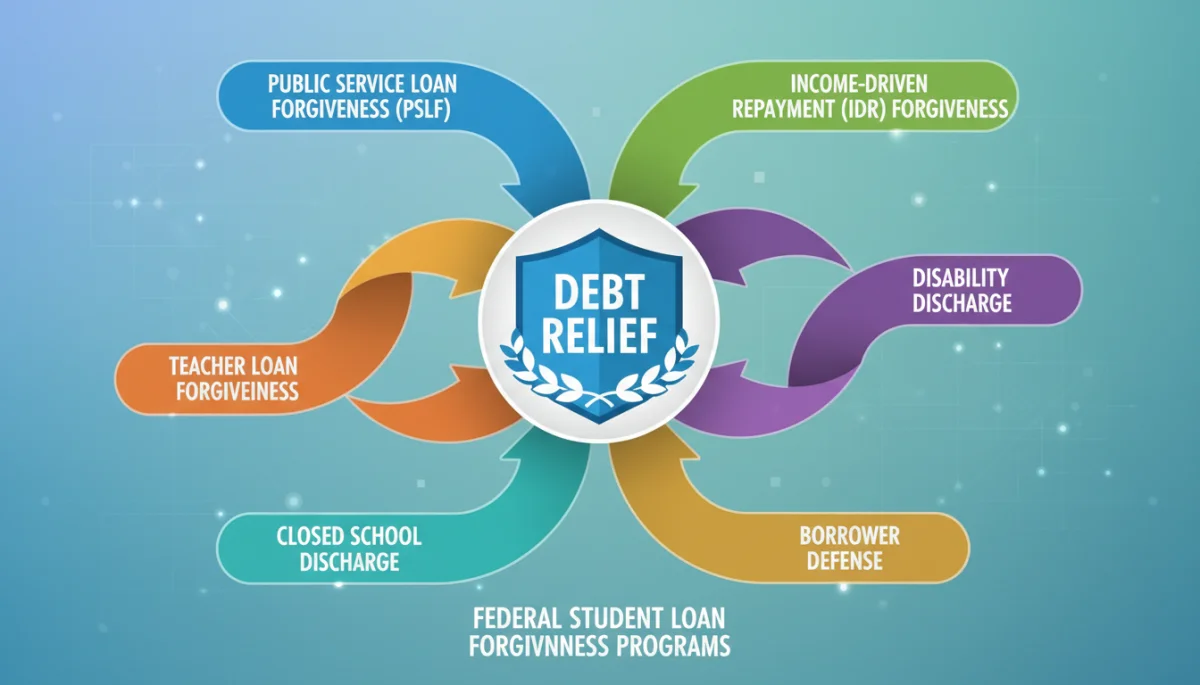 The remaining balance is forgiven after the specified repayment period, though it’s important to note that the forgiven amount may be considered taxable income by the IRS.
Types of IDR plans and their unique features
There are several IDR plans, each with slightly different terms regarding payment calculations, eligibility, and forgiveness timelines. Choosing the right plan is crucial for maximizing your potential for forgiveness.
- Revised Pay As You Earn (REPAYE) Plan: Generally sets payments at 10% of discretionary income, with forgiveness after 20 years for undergraduate loans and 25 years for graduate loans.
- Pay As You Earn (PAYE) Plan: Also sets payments at 10% of discretionary income, but caps them at the 10-year Standard Repayment Plan amount. Forgiveness after 20 years.
- Income-Based Repayment (IBR) Plan: Payments are 10% or 15% of discretionary income, depending on when you took out your loans. Forgiveness after 20 or 25 years.
- Income-Contingent Repayment (ICR) Plan: Payments are the lesser of 20% of discretionary income or what you would pay on a 12-year fixed repayment plan. Forgiveness after 25 years.
Regularly recertifying your income and family size is a mandatory annual step for all IDR plans. Failure to do so can result in higher payments or even capitalization of interest, potentially increasing your overall loan balance.
Teacher loan forgiveness: supporting educators
For dedicated educators, the Teacher Loan Forgiveness program offers a specific avenue for relief, recognizing the invaluable contributions teachers make to communities. This program allows eligible teachers to receive up to $17,500 in loan forgiveness on their Direct Subsidized and Unsubsidized Loans and their Subsidized and Unsubsidized Federal Stafford Loans.
To qualify, teachers must meet specific criteria related to their teaching service, the school where they teach, and the type of loans they hold. It’s a targeted program designed to incentivize and retain teachers in high-need schools and subject areas.
Requirements for teacher loan forgiveness
Understanding the precise requirements is crucial for teachers looking to benefit from this program. The criteria are quite specific and must be met without exception.
- Eligible schools: You must teach for five complete and consecutive academic years in a low-income school or educational service agency. The U.S. Department of Education maintains a searchable database of eligible low-income schools.
- Eligible loans: Direct Subsidized and Unsubsidized Loans and Federal Stafford Loans (Subsidized and Unsubsidized) qualify. PLUS loans and Perkins Loans are not eligible under this program.
- Certification: Your chief administrative officer at the school where you performed your qualifying teaching service must certify your eligibility.
The amount of forgiveness depends on the subject area taught; highly qualified mathematics or science teachers at the secondary level, and highly qualified special education teachers, are eligible for the maximum $17,500. Other eligible teachers can receive up to $5,000 in forgiveness. This program can be a significant benefit for those committed to a teaching career.
Total and permanent disability (TPD) discharge
The Total and Permanent Disability (TPD) discharge offers a critical lifeline for borrowers who are unable to engage in any substantial gainful activity due to a physical or mental impairment. This program allows for the complete discharge of federal student loans, providing immense relief during challenging times.
Eligibility for TPD discharge can be established through three different methods, each requiring specific documentation and verification. It’s a rigorous process designed to ensure that only those truly unable to work receive this significant benefit.
Methods to qualify for TPD discharge
There are three primary ways to demonstrate eligibility for a TPD discharge, each with its own set of requirements and documentation:
- Veterans Affairs (VA) determination: If the VA has determined that you have a service-connected disability that is 100% disabling or you are totally disabled based on an individual unemployability determination, you can qualify.
- Social Security Administration (SSA) notice: You can qualify if you receive Social Security Disability Insurance (SSDI) or Supplemental Security Income (SSI) benefits and your notice of award states that your next scheduled review is five to seven years or more from the date of your last SSA disability determination.
- Physician’s certification: A licensed medical doctor can certify that you are unable to engage in any substantial gainful activity due to a physical or mental impairment that can be expected to result in death, has lasted for a continuous period of not less than 60 months, or can be expected to last for a continuous period of not less than 60 months.
Once approved for a TPD discharge, there is a three-year monitoring period during which borrowers must meet certain income requirements. Failing to meet these requirements can result in the reinstatement of the discharged loans, underscoring the importance of understanding the post-discharge obligations.
Other federal student loan forgiveness and discharge options
Beyond the major programs like PSLF, IDR forgiveness, Teacher Loan Forgiveness, and TPD discharge, several other federal student loan forgiveness and discharge options exist, addressing various unique circumstances. These programs are often less widely known but can provide crucial relief for eligible borrowers facing specific challenges.
It is worth exploring these additional options, as they might apply to your particular situation, offering pathways to alleviate your student debt burden that you might not have considered. Each program has specific eligibility requirements and application processes, so thorough research is key.
Exploring specific discharge and forgiveness categories
These specialized programs cover a range of scenarios, from school misconduct to the unfortunate event of a borrower’s death.
- Borrower defense to repayment: If you were defrauded by your school or your school engaged in misconduct in violation of certain state laws, you might be eligible for this discharge.
- Closed school discharge: If your school closed while you were enrolled or shortly after you withdrew, and you were unable to complete your program, you might qualify.
- False certification discharge: If your school falsely certified your eligibility to receive a loan, such as certifying your ability to benefit from higher education when you couldn’t, you might be eligible.
- Unpaid refund discharge: If your school failed to return required loan funds to your lender, you might be eligible for a discharge of the portion of the loan that should have been refunded.
- Death discharge: Federal student loans are discharged if the borrower dies. This also applies to PLUS loans taken out by parents if either the student or the parent borrower dies.
Understanding the full spectrum of federal student loan forgiveness programs is critical. Many borrowers are unaware of all the options available, potentially missing out on significant financial relief. It is always advisable to consult with a financial aid advisor or directly with your loan servicer to determine your eligibility for any of these programs.
Navigating the application process and avoiding pitfalls
Once you’ve identified a potential federal student loan forgiveness program, the next crucial step is navigating the application process. This stage often involves detailed paperwork, adherence to strict deadlines, and careful communication with your loan servicer or the Department of Education. Many borrowers encounter challenges during this phase, underscoring the importance of meticulous preparation and vigilance.
A common pitfall is misunderstanding the specific documentation required for each program. For instance, PSLF requires annual employment certification, while TPD discharge necessitates specific medical or government agency documentation. Submitting incomplete or incorrect information can lead to significant delays or even outright denial of your application, prolonging your debt burden.
Key strategies for a successful application
To maximize your chances of a successful application, consider these essential strategies:
- Read instructions carefully: Before filling out any forms, thoroughly read all instructions provided by your loan servicer or the Department of Education.
- Gather all required documents: Compile all necessary paperwork, such as employment verification forms, income statements, or medical records, well in advance.
- Keep detailed records: Maintain copies of everything you submit, including application forms, supporting documents, and any correspondence with your loan servicer. Note dates, names of representatives, and confirmation numbers.
- Communicate proactively: If you have questions or encounter issues, reach out to your loan servicer or the Department of Education promptly. Don’t wait for problems to escalate.
- Be aware of scams: Unfortunately, there are many fraudulent companies that promise loan forgiveness for a fee. Always remember that federal student loan forgiveness applications are free.
The application process can be lengthy, so patience and persistence are vital. Regularly checking the status of your application and following up on any requests for additional information will help ensure a smoother journey toward achieving federal student loan forgiveness.
| Key Program | Brief Description |
|---|---|
| PSLF | Forgiveness after 120 qualifying payments for public service employment. |
| IDR Forgiveness | Loan balance forgiven after 20-25 years of income-driven payments. |
| Teacher Loan Forgiveness | Up to $17,500 forgiven for qualifying teachers in low-income schools. |
| TPD Discharge | Full loan discharge for borrowers with total and permanent disabilities. |
Frequently asked questions about student loan forgiveness
Loan forgiveness typically relates to programs based on your employment (like PSLF), while discharge usually refers to circumstances like total and permanent disability, death, or school closure. Both result in the elimination of your loan debt, but the qualifying conditions differ significantly.
In many cases, yes, the amount of a forgiven student loan can be considered taxable income by the IRS. However, there are exceptions, such as PSLF, which is generally not taxable. It’s crucial to consult a tax professional for personalized advice on your specific situation.
Generally, defaulted federal student loans are not eligible for forgiveness until they are brought out of default. Options like loan rehabilitation or consolidation can help you resolve the default status, making you eligible for forgiveness programs once your loans are in good standing.
The application process varies by program. For PSLF, you submit an Employment Certification Form annually and a final application for forgiveness. For IDR forgiveness, it’s typically automatic after the repayment period. For TPD, you apply through Nelnet. Always refer to official Department of Education resources for specific instructions.
FFEL and Perkins Loans are generally not directly eligible for most federal forgiveness programs. To qualify, you typically need to consolidate them into a Direct Consolidation Loan. This makes them federal direct loans, which are eligible for programs like PSLF and IDR plans.
Conclusion
Navigating the complex world of federal student loan forgiveness programs is a significant undertaking, but one that can lead to substantial financial relief. From the Public Service Loan Forgiveness program designed for dedicated public servants to income-driven repayment plans that adjust to your financial capacity, and specialized options for teachers or those with disabilities, a diverse array of pathways exists. Understanding the specific eligibility criteria, application processes, and potential tax implications of each program is paramount. By staying informed, meticulously documenting your journey, and proactively engaging with official resources, borrowers can confidently pursue the forgiveness options that best align with their unique circumstances, ultimately moving closer to financial stability and freedom from student debt.
